We have found
46590
results matching your criteria.
Please wait while we search...
(E)-para-methoxycinnamaldehyde
(E)-para-methoxycinnamaldehyde is a flavor and fragrance compound known for its spicy, floral, cinnamon-like aroma, found naturally in basil and tarragon oil.
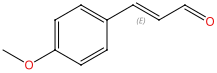
General Material Description
(E)-para-methoxycinnamaldehyde is an aromatic aldehyde belonging to the cinnamaldehyde chemical class, bearing a methoxy group at the para position of the phenyl ring. Its molecular formula is C10H10O2 and it appears as a colorless to pale yellow liquid. The compound is recognized for its spicy, floral, sweet cinnamon, cherry, and vanilla sensory notes, making it valuable in flavor and fragrance applications. Synonyms include trans-4-Methoxycinnamaldehyde and cinnamaldehyde,trans-p-methoxy-. It is listed under the PubChem identifier 641294. Naturally occurring in botanical sources like basil and tarragon oil, (E)-para-methoxycinnamaldehyde is typically isolated or synthetically produced for use as a flavoring and fragrance agent.
Occurrence, Applicability & Potential Uses
(E)-para-methoxycinnamaldehyde occurs naturally in various plants, including basil, baked potato aroma, and tarragon oil. Its distinctive aromatic profile contributes balsamic, cassia, cinnamon, floral, fruity, honey, maple, spicy, tobacco, and vanilla notes in fragrance compositions. In flavoring, it serves particularly to enhance licorice and red licorice profiles. This compound’s functional role in formulations is recognized under standards such as the FEMA (US) guidance for flavoring substances, ensuring its appropriate use in consumer products. Its characteristic scent and flavor properties make it a versatile ingredient in both fragrance and flavor industries.
Physico-Chemical Properties Summary
(E)-para-methoxycinnamaldehyde exhibits physical properties influencing formulation performance. It has a melting point range between 44 to 48°C at atmospheric pressure and boils between 144 and 161°C at reduced pressures, reflecting moderate volatility. The estimated logP of 1.953 indicates balanced lipophilicity, aiding solubility in organic solvents such as alcohols. Water solubility is low but measurable, approximately 1598 mg/L at 25°C. Vapor pressure at room temperature is very low (0.001 mmHg), which affects its evaporation rate in applications. The flash point is reported as 230°F (about 110°C), suggesting relative safety under controlled handling conditions. These physicochemical characteristics govern the compound’s stability, handling, and release profile in end-use products.
FAQ
What is (E)-para-methoxycinnamaldehyde and what are its main properties?
(E)-para-methoxycinnamaldehyde is an aromatic aldehyde used primarily in flavor and fragrance formulations. It contains a para-position methoxy group on the cinnamaldehyde structure, imparting a spicy, floral, cinnamon-like odor with sweet undertones. This compound appears as a colorless to pale yellow liquid with moderate volatility and solubility properties. Its CAS number is 24680-50-0, and it is recognized for its organoleptic contributions in various aroma compositions.
Where does (E)-para-methoxycinnamaldehyde occur naturally and how is it applied industrially?
(E)-para-methoxycinnamaldehyde naturally occurs in plants such as basil, baked potato aroma, and tarragon oil. Industrially, it functions as a flavoring and fragrance agent delivering balsamic, cinnamon, floral, and sweet notes. Its applications cover enhancing the aroma profiles of licorice flavors and contributing complex spicy and vanilla elements in perfumery. Its use is guided by industry standards to optimize sensory impact while considering safety.
What safety regulations and sourcing information apply to (E)-para-methoxycinnamaldehyde?
(E)-para-methoxycinnamaldehyde is classified as an irritant under European regulations, prompting precautions to avoid skin and eye contact. The IFRA (Global) Code of Practice recommends a maximum usage level of 3.0% in fragrance concentrates. Safety data sheets provide detailed handling guidance, and sourcing typically involves synthetic manufacture or extraction from natural botanicals. Regulatory references include FEMA (US) listings and various chemical safety databases, ensuring compliance with global standards.
US / EU / FDA / JECFA / FEMA / Scholar / Patents
| Google Scholar | Start search |
| Google Books | Start search |
| Google Patents | Start search |
| Perfumer & Flavorists | Start search |
| EU Patents | Start search |
| PubMeb | Start search |
| NCBI | Start search |
Other Information
| (IUPAC): | Atomic Weights of the Elements 2011 (pdf) |
| Videos: | The Periodic Table of Videos |
| tgsc: | Atomic Weights use for this web site |
| (IUPAC): | Periodic Table of the Elements |
| CHEMBL: | View |
| Metabolomics Database: | Search |
| KEGG (GenomeNet): | C10475 |
| HMDB (The Human Metabolome Database): | HMDB32611 |
| Export Tariff Code: | 2912.49.2600 |
| VCF-Online: | VCF Volatile Compounds in Food |
| ChemSpider: | View |
General Material Information
| Preferred name | (E)-para-methoxycinnamaldehyde |
| Trivial Name | trans-4-Methoxycinnamaldehyde |
| Short Description | cinnamaldehyde,trans- p-methoxy- |
| Formula | C10 H10 O2 |
| CAS Number | 24680-50-0 |
| FDA UNII | 54098389BL |
| Nikkaji Number | J185.780K |
| MDL | MFCD00017343 |
| Bio Activity Summary | External link |
| NMR Predictor | External link |
| Synonyms |
|
PhysChem Properties
| Material listed in food chemical codex | No |
| Molecular weight | 162.18809509277 |
| Melting Point | 44 to 48°C @ 760 mm Hg |
| Boiling Point | 160 to 161°C @ 12 mm Hg |
| Boiling Point | 144 to 145°C @ 7 mm Hg |
| Vapor Pressure | 0.001 mmHg @ 25 °C |
| Flash Point TCC Value | 110 °C TCC |
| logP (o/w) | 1.953 est |
| Solubility | |
| alcohol | Yes |
| water, 1598 mg/L @ 25 °C (est) | Yes |
| water | No |
Organoleptic Properties
| Odor Type: Spicy | |
| spicy, floral, sweet, cinnamon, cherry, vanilla | |
| General comment | At 100.00 %. spicy floral sweet cinnamon cherry vanilla |
Occurrences
| (data available) |
Potential Uses
| Applications | |
| Odor purposes | Balsam , Cassia , Cinnamon , Floral , Fruit , Honey , Maple , Spice , Tobacco , Vanilla |
| Flavoring purposes | Licorice red licorice |
Safety Information
Safety information
| Preferred SDS: View | |
| European information : | |
| Most important hazard(s): | |
| Xi - Irritant | |
| R 36/38 - Irritating to skin and eyes. S 02 - Keep out of the reach of children. S 24/25 - Avoid contact with skin and eyes. S 26 - In case of contact with eyes, rinse immediately with plenty of water and seek medical advice. S 36 - Wear suitable protective clothing. | |
| Hazards identification | |
| Classification of the substance or mixture | |
| GHS Classification in accordance with 29 CFR 1910 (OSHA HCS) | |
| None found. | |
| GHS Label elements, including precautionary statements | |
| Pictogram | |
| Hazard statement(s) | |
| None found. | |
| Precautionary statement(s) | |
| None found. | |
| Oral/Parenteral Toxicity: | |
| Not determined | |
| Dermal Toxicity: | |
| Not determined | |
| Inhalation Toxicity: | |
| Not determined | |
Safety in use information
| Category: | |||
| flavor and fragrance agents | |||
| RIFM Fragrance Material Safety Assessment: Search | |||
| IFRA Code of Practice Notification of the 49th Amendment to the IFRA Code of Practice | |||
| Recommendation for (E)-para-methoxycinnamaldehyde usage levels up to: | |||
| 3.0000 % in the fragrance concentrate. | |||
Safety references
| EPI System: View |
| AIDS Citations:Search |
| Cancer Citations:Search |
| Toxicology Citations:Search |
| EPA Substance Registry Services (TSCA):24680-50-0 |
| EPA ACToR:Toxicology Data |
| EPA Substance Registry Services (SRS):Registry |
| Laboratory Chemical Safety Summary :641294 |
| National Institute of Allergy and Infectious Diseases:Data |
| WGK Germany:3 |
| (E)-3-(4-methoxyphenyl)prop-2-enal |
| Chemidplus:0024680500 |